
options tourism is not recommended
My RSS feed showed this today:
At the Robinhood Summit last week, Mat Cashman and I hosted a “Trading Lab” emphasizing that options are surgical tools. You only want to reach for them when you have a specific view. While their payoff is highly levered to nailing a particular timing, they are unforgiving to vague forecasts like “I generally want to be long this stock”.
The quote is from Kris Abdelmessih and the full post is here
Kris’s statement is spot on and the appropriate internalization is “I either learn this options thing through and through or I stay the f*** away.”
Here is an example of a recent event with a potential trade and the final decision to do nothing.
GoPro gets acquired
GPRO has been on my list since forever because I love their cameras (even though they fail during surf sessions) and their commercials (the HERO3+ is epic).
On September 1, GoPro announces that the company will be acquired by Starman Optical for $1.14 per share and existing shareholders will retain 10% of the combined company.
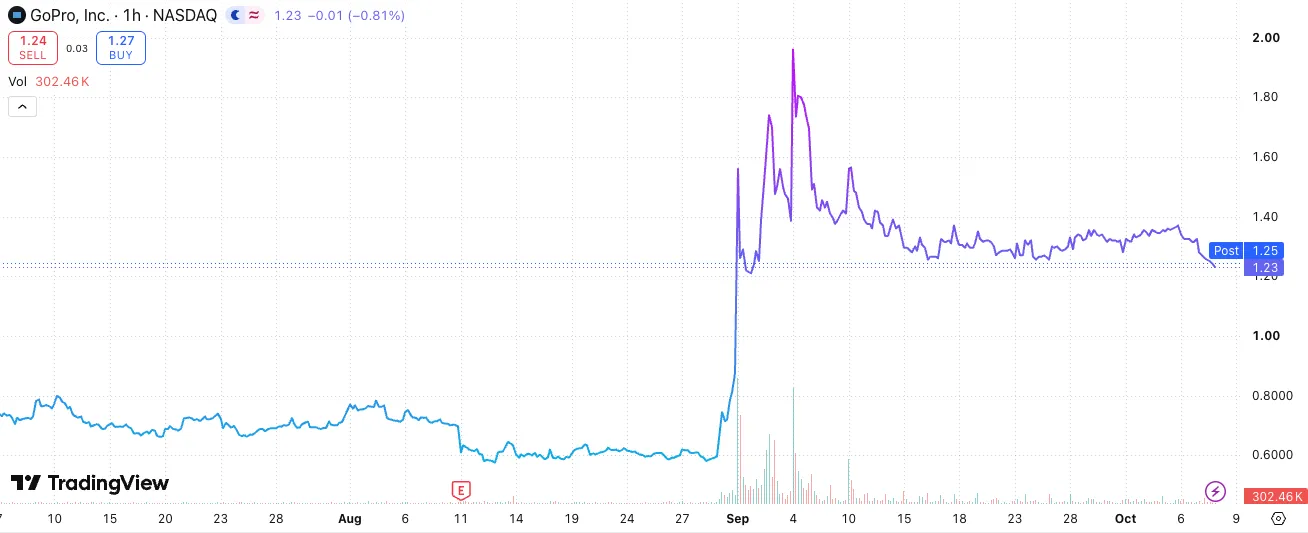
The stock shoots up to $1.70. “Makes no sense,” I think.
A couple of days later, I looked again and it was trading at $1.52. “This has to go down to $1.14. Let’s look at puts.”
the obvious trade: the $2.00 put
The September put options chain looked like this:
| Strike | Bid | Ask |
|---|---|---|
| $1.00 | $0.00 | $0.05 |
| $1.50 | $0.20 | $0.25 |
| $2.00 | $0.60 | $0.65 |
| $3.00 | $1.40 | $1.60 |
| $4.00 | $2.00 | $2.75 |
The $2 put at $0.65 seemed like the place to start.
With GPRO at $1.52, the option already had $0.48 of intrinsic value:
$2.00 - $1.52 = $0.48
So I would have been paying about $0.17 of time value.
The expiration break-even was:
$2.00 - $0.65 = $1.35
If GPRO reached $1.14 by expiration, the put would be worth $0.86.
That would leave a profit of:
$0.86 - $0.65 = $0.21
A profit, but a lot less exciting than one would expect. The underlying could fall from $1.52 to $1.14 (a 25% drop in less than a month!) and the option buyer would capture only part of that move.
next: the $1.50 and $1.00 puts
The $1.50 put was offered around $0.25.
Its expiration break-even was:
$1.50 - $0.25 = $1.25
At $1.14, it would be worth $0.36, for a profit of about $0.11.
The $1 put could be bought for roughly $0.05, but that was no longer really a bet on convergence toward the acquisition price. GPRO could fall to $1.14 and the option would expire worthless.
Everything looked messy. Cheap or expensive in different ways.
The $2 put gave the exposure I wanted but charged quite a bit for it.
The $1.50 put cost less but required the stock to get much closer to the acquisition price before the trade worked.
The $1 put was perhaps not even tradable.
GPRO’s path
Over the following days, GPRO started moving lower. A gradual decline toward the acquisition price.
My prediction on overall direction was right, but the speed and path were not.
The $1.50 puts had an implied volatility (IV) of 227%; the $2.00s, 287%.
That’s the market way to (try to) price uncertainty.
Waiting for price convergence could have killed the returns as time value and IV collapse.
how about a vertical?
Since the IVs were extremely high, perhaps a put spread could improve the economics.
$2.00/$1.50 put spread:
- buy the $2.00 put ($0.65 ask)
- sell the $1.50 put ($0.20 bid)
Net cost:
$0.65 - $0.20 = $0.45
The maximum value of the spread at expiration was $0.50.
So at the quoted markets I would risk $0.45 to make at most $0.05.
No, thank you
The original observation was still reasonable. If things proceed as expected, GPRO has to move lower.
But as one tries to express that view in the market, one encounters things that a tourist wouldn’t see:
- expensive IV
- wide spreads
- time decay
- extreme path dependency
The stock closed at $1.22 today. I would have made some money with the long $2.00 puts, but the expected payoff was too small and the margin for error too thin.
So I passed.